Archive for the 'Spark Arrester' Category

Compare Spark Arrestors

Auto Date Wednesday, August 25th, 2010

(A comparison of different methods)

There are several approaches to the issue of extinguishing sparks in a gas stream.

Important Factors in Spark Arrestor Selection

(1) There is no such thing as an efficiency rating for spark arrestors. They either work or they don’t. Remember, it takes only one spark/ember getting through the device to cause a fire or explosion.

(2) Maximum turbulence is the key to effective spark arresting and in the selection of a spark arresting device. Some devices do not impart enough turbulence (and/or pressure drop) to be 100% effective. The recommended pressure drop for an in-line device (one that is installed in a section of the ductwork) is between 0.75 and 1.5 inches WC. Anything less is highly risky. This is a basic law of physics.

(3) Pressure drop across a QUENCHER style of spark arrestor is a function of the Reynolds number which is proportional to the density for air. This means that a unit can be sized smaller if operating at a higher temperature. For instance a spark arrestor operating at 440 degrees F is 2/3 the size of the typical unit applied at 70 degrees F and the pressure drop will be designed the same. This lowers the cost of the spark arrestor and ensures its effectiveness. The density is also affected by the water vapor in the gas stream. It has little effect at temperatures below 125oF but can be a major factor when operating at higher temperatures.

(4) If the gas stream has dust that might drop out in the duct at the velocities in the blender style or QUENCHER spark arrestor, a booster must be provided to periodically remove this accumulation. If this unit is not kept clean, it might pose a threat by putting an extra load on the ductwork. Without an automatic duct cleaner-booster system, the spark arrestor would require periodic manual cleaning.

(5) The duct cleaner – booster design is also temperature sensitive and must be altered to accommodate changing gas stream conditions.

(6) Most suppliers do not have the capability to modify the designs as referred to in item (3), (4) & (5) above.

Blender Type Air Mixers

A number of these air blender/mixers have been applied with varied success as in-line spark coolers, arrestors and suppressors. Over the last several years standard air mixers have been adapted and applied between the spark generating process and dust collector. They were applied in processes where fires in the dust collectors had previously occurred. One supplier hired a consultant to develop a market for these air blender/mixers as a spark arrestor/cooler. This air blending or mixer style design was an outgrowth of mixing two gas streams of different temperatures to insure a uniform temperature after the static mixer. It was deduced that the gas stream produced turbulent flow as it passed through the blades and this was the reason it could be adapted to spark cooling. However, these are air mixers first and spark arrestors second. They are marketed as having low pressure drop (maximum 0.5 inch WC) through them. There are performance limitations because not enough turbulence (and related pressure drop) is imparted to the spark/ember. To achieve spark suppression, we need to go from laminar to highly turbulent flow in the duct which strips away the hot air envelope around the spark/ember thereby cooling it and starving it of fuel (oxygen). For air blending this is not a requirement. Also, these devices have large gaps between the mixing blades, when looking through the inlet and downstream of the device. These gaps can allow a percentage of sparks/embers to slip through and cause a fire or even an explosion in the dust collector.

Improved In-Line Spark Arrestors

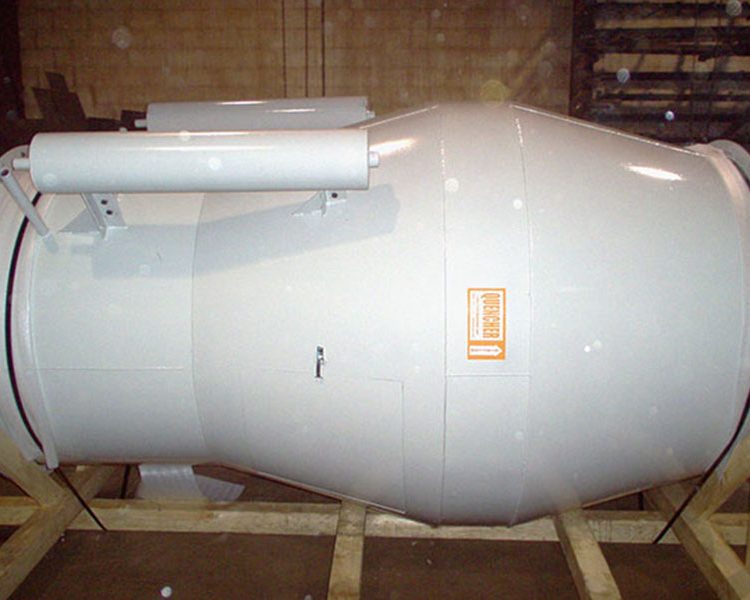
QAM developed the QUENCHER, which is a variation of the blender/mixer design. It is also an in-line spark arrestor. Employing a 60 year old spin vane mist eliminator technology developed by Sly Manufacturing in the early 1960’s, led QAM to vary the blade designs to have the most effective performance, inducing maximum turbulence to the gas stream, and lowering the cost. Maximum turbulence (and the pressure drop that results from it) is the key to spark arresting. After several tests it was found that the air blending/mixer design did not impart enough turbulence and some sparks got through, especially at low gas stream velocities. Eventually, there was a specific design which imparted the most effective swirling and turbulence thereby extinguishing the sparks quickly and most effectively. In fact, during testing of the QUENCHER, the arrestor cell would light up as a ball of fire, however, one inch past the cell nothing was left in the gas stream. These designs were incorporated into the QUENCHER. QAM has developed special application data in which the blade angles are adjusted to produce minimum effective pressure drop for different temperatures and gas densities. To our knowledge, no one else accounts for the gas density effects on spark arrestors. In truth, due to the advanced design, even applying the incorrect parameters to a QUENCHER may not result in a failure to put out sparks. Since the pressure drop across the device are a function of the velocity through it, the development of a pneumatically operated booster was introduced to prevent dust dropout accumulating in the static arresting cell. It also blows out accumulations on the blades.

Link to Quencher spark arrestor

Liquid Spray Systems

For many years these systems were the only method to prevent fires caused by sparks. The system consists of electronic detectors that detect sparks and react to their presence. When a spark is detected liquid sprays are actuated and water sprayed into the duct. The sprays actually cool the gas stream below the dew point. However, in dust collection systems, the water then wets the filter bags or cartridges. This prevents fires but the gas flow is interrupted and the bags must be either replaced or dried out before the process can resume. It takes a whole day or two to dry out the bags or even to prevent blinding and replacement. The detector sensitivity can be lowered to prevent excessive actuations, but, this reduces the reliability of the systems. The detector missing a spark is an ever present danger and a fire may occur. Bag or cartridge replacement is definitely required.

Cyclone Dust Collectors

Contrary to common belief cyclones are not effective spark arrestors. For a spark arrestor / cooler to work, there must be high turbulence in the air stream. If you have turbulence in a cyclone the pressure drop is very high. Cyclones are designed to avoid turbulence. Many bag house fires occur in systems with cyclone pre-cleaners. Amazingly the inlet baffles on the baghouse are more effective as spark arrestors, however they are not foolproof.

Static Blade Spark Suppressor (Tri Pass)

These were developed in Japan to replace multiple cyclones in coal fired boilers. They found that the multiple cyclones did not stop sparks from entering the dust collectors. The first ones were installed in the early 1970’s. They ran at 1.5 inches of pressure drop and were fabricated from structural angles to resist the wear of the abrasive ashes in the coal that they fired. There are several of these applications installed in the USA and Canada designed by one of our colleagues.

Static Baffle-Box Spark Arrestor

Many dust collector suppliers offer this type of device as a spark arrestor. It consists of air entering at one end of a baffle box running over a baffle plate which drops out the sparks and much of the dust collected. The air exits at the other end, and then travels to the dust collector. The big drawback is that a hopper and flexible or solid hose connection to a collection barrel is required. Also, these devices do not eliminate all of the sparks. There is not enough turbulence generated to ensure 100% spark arresting. Sparks may also ignite the contents of the collection bin under it.

Mesh Filters

This is a common stop-gap measure where the filter is placed at the exhaust duct of hoods or installed in the ductwork. When clean, the mesh filter will stop at best 80% of sparks. These filters do not produce enough pressure drop to be fully effective. It only takes one spark to ignite dust in the duct or set a dust collector on fire. The only thing these filters do is clog up and add to your maintenance.

We trust that the above information will enable you to evaluate and select the most suitable method and supplier for your application. Buying our QUENCHER/BOOSTER spark arrestor combination will give you a risk free unit, fine tuned for each application.

Plasma/Laser Cutters Cause Fires

Auto Date Friday, May 21st, 2010

Some people have used Quenchers, and other style spark arrestors in plasma and laser cutting applications but still experienced fires in their dust collectors. Sparks are only one issue to deal with these applications. A good spark arrestor is definitely needed to stop sparks and embers, but, it is no guarantee against fires in the dust collector.

The problem:

1. The operator may have to reset the heat setting of the plasma head. It could be generating too much atomic static particles. This causes a “painting” effect on the cartridge media, eventually clogging it.

2. Large heavy particles of molten metal can be generated in the process. 

3. You should use spun bond wide pleat cartridges, to ensure proper clean out of the cartridges. That way the dust will spread over a large surface of media, instead of on the outer surface only.

 4. Current cartridges that are clogging over time (can vary from hours to weeks, depending on loading). When clogging occurs, the air flow drops and sparks can slip through any spark arrestor (not just the Quencher). This sets fire to the combustible dust accumulated on the surface of the cartridges.

Normally, plasma cutters have different characteristics depending on the settings of the cutter torch. The quantity of dust produced is relatively small. At some torch settings the dust is reactive by initiating an atomic bond between the dust and the surface of the cartridge, forming a hard durable impervious coating which totally or partially plugs the filter media. This mechanism is an inherent part of the plasma coating process to put wear resistant coatings on shafts, turbine blades etc. that allow the parts to receive very long lives. In the plasma coating machinery, the key to collecting the overspray in cartridge or fabric collectors is to allow the atomic bond to dissipate. This is accomplished by extending the time that particles travel from the torch to the filter media elements. In plasma coating systems at this time, depending on torch settings will vary from 0.5 to 0.8 seconds depending on the metals being sprayed. 

In plasma cutting applications often the dust being emitted from the torch does not require any special considerations. In fact, collectors can operate for many months quite well with moderate pressure drops. Then the torch settings are changed because of various factors such as the composition or thickness of the pieces that are cut. As the settings of the gun or the speed of the cut is changed, the dust can act as a plasma coating torch and the cartridges start plugging. Sparks are often produced. If the dust is combustible the sparks may ignite the coating on the cartridges. Normally the fuel on the cartridge surface is not very heavy so the fires do not damage the housing of the collector. The cartridges are then usually replaced. The QUENCHER spark arresters are sometimes applied to limit the risk of fires and extend cartridge life. In the tandem horizontal type collectors, the cartridges are usually tight spaced, so, as the pressure drop rises, the pleats are pinched in the valleys so the pressure drop goes up. Combustible dusts can put pounds of dust to be stored in the cartridges to fuel a fire in the collectors. However, the squeezing of the pleats also causes pressure drop to increase and slow the flow through the dust collector. This often allows dust to be released into the work area. 

Although spark arrestors will protect the system from sparks, pieces of molten metal go through the spark arrestor unaffected. These heavy, hot particles lodge on the surface of the cartridge and ignite the combustible dust coating. The heavy molten particles need to be dropped out of the system prior to the spark arrestor and collected safely, so as not to cause a fire in that collection device. Cyclones and drop out boxes are sometimes used for this. However, be aware that these devices have little effect on sparks / embers which are light buoyant particles and slip through to the dust collector. 

An excellent example of these effects was the experience of the Day division of Donaldson who supplies this design. In cutting the filter mounting plates for their design they plasma cut holes in a 1/4 inch thick plate. They found that the filters plugged quickly in the after filters. They added distance in the filters venting the operations. This experience occurred 20 years ago and we do not know how this operation is now performing. 

Our recommendation is to replace the current cartridges with a wide spaced stiffened spun bond media carried and precoat the cartridges with a 1/64 inch thick coating of inert pre-coat material. 

We suggest you send each job application data (layouts & pictures) to QAM technical support at garyb@qamanage.com and/or call him at 800-267-5585. We’ve dealt with plasma cutting applications for decades and feel that yours would be a common problem. If you contact us, we’ll be happy to work with you on this. 

For more information on; Quencher spark arrestor

For more information on; Dust collectors and dust collection solutions

Spark Arresters Prevent Fires

Auto Date Wednesday, April 15th, 2009

Transport of sparks through ducts; Referring to the sketch below, there is a glowing ember (red particle) surrounded by some hot air (yellow envelop) which gives the spark buoyancy. This spark and the hot gas associated with it can travel hundreds of feet in a duct. The ductwork is designed to give laminar (smooth ) flow. This is illustrated on the left. Spark suppressors are placed in the duct to change the flow to turbulent (coarse) flow, as shown on the right. This agitation or turbulence strips the air from around the ember thereby removing the fuel (oxygen), therefore extinguishing and cooling the spark below ignition temperature (pink particle).

Spark arrester

Spark arrester

Prevention depends on eliminating the causes of ignition. Spark traps can change laminar to turbulent flow and extinguish any sparks in a duct. Design duct systems for proper dust transport velocities. Install a pneumatic actuated duct booster to flush dust into the dust collector. Use air jets to remove electrostatic charges on the duct surfaces.

Quencher Spark Arrester, click here.