Explosions and Fires

Auto Date Wednesday, January 13th, 2010

Part 1 – Explosions in dust collectors
Dust explosions are possible whenever the process produces combustible dusts. Not all combustible dusts will produce explosions. For instance, even combustible dusts may not have the characteristics to produce an explosion. A coarse combustible dust such as coal may burn well but not explode depending on how fine the dust is. To produce a conflagration the dust must have a sufficient ratio of surface area to weight to sustain the rapid oxidation for creating and sustaining an explosion. When a dust can sustain an explosion, the dust concentration must be within the explosive limits.  These are often defined as:
L.E.L. (Lower Explosive Limit): Below this level of concentration, an explosion will not occur and propagate itself. There is not enough concentration of fuel to allow the flame front to grow. A typical range of values would be 20-30 grains/ cubic foot.
U.E.L. (Upper Explosive Limit): Above this limit the concentration of dust is so high that there is insufficient oxygen to oxidize the fuel and the unburned fuel stops the spread of the flame front.

Ignition of the dust depends on several factors
 (1) Chemical Composition
 (2) Shape and fineness, briefly described above.
(3) Dust distribution in the gas stream or atmosphere
(4) Concentration of oxygen in the gas stream.
 (5) Initial temperature and pressure of the gas.
 (6) Energy level available to detonate the explosion

Intensity of the explosion is dependent on the rate of pressure rise and maximum pressure developed. Factory Mutual ran lab tests to determine these values and are contained in their publications. It must be pointed out these tests and values are run with a spherical test chamber with power ignition source in the center of the sphere. These numbers are relatively high when referring to explosions in a dust collector housing, because the bags usually obstruct the expansion of the explosive flame front.

Limiting exposure to hazards
 A) Eliminate ignition sources. One source of ignition is sparks, often produced in the hoods venting processing machines. Sometimes the machinery can be modified to prevent spark generation. Another method is to install spark suppressors prior to the dust-laden gas entering a dust collector. For sparks to be carried along to the collector the flow must be laminar. Most dust collection ductwork is deliberately designed to operate with laminar (smooth) flow to reduce pressure drop but laminar flow produces a system that is an excellent vehicle to send sparks into a dust collector. Recently, there are offered some excellent designs of spark coolers that turn laminar flow into turbulent flow for very short distances then revert back to laminar flow. These devices require pressure drops of less than one inch water column and are easily installed. An automatic self cleaning device for these spark suppressors is available.
 B) Isolate Operations. The collectors may be located outdoors or away from the main production areas.
 C) Introduce inerting systems. Inert dust can be introduced into the system so that the lower explosive limit of the dust mixture can be eliminated therefore the mixture will not explode. This is especially effective where the dust concentration is very low. As an example, if we have a fume dust with loading of 1 grain per thousand cubic feet of gas which is combustible, and the system has 25,000 CFM, adding an inert dust at double that load to prevent it from burning would require:
 25,000 CFM  x 2 gr./ 1000 CFM  x  60 min./hr x 8 hrs/shift =24,000 gr./shift
24,000 gr./shift divided by7000 grains/ lb. = 3.4 lb./shift.
The other possibility is to mix the gas with another gas stream that may have the oxygen already oxidized as with a combustion process.
D) Explosion Vents can be provided on ducts and on the collector housings. These vents must be directed either outdoors or to an area where the explosion can be safely dissipated.
E) Changes in Design of collectors The collectors can be braced to withstand higher pressures so the explosion venting is more effective. Cylindrical collectors are more resistant to damage then rectangular collectors but rectangular units can be braced to withstand higher explosive pressures. Grounded bags are often supplied to drain off the static electricity charge that is a possible source of ignition. Grounded bags can provide a false sense of security to the operator and designers. Most often the dust that holds a charge insulates the static charge from the media. When the filter element is cleaned, sparks can be generated.
F) Changes in operation of electrical controls; Referring to figure 1, which is a view if a cylindrical bag in a Pulse jet collector.

Pulsed bag

The bag is the cylinder between the two dark hollow sections of cylinders. When the bag is cleaned a small volume of dirty air is propelled from the bags and extends a fraction of an inch between the bags. This forms a hollow cylinder of dust laden agglomerated dust. It is this hollow cylinder which is possibly between the LEL and UEL. Even if a source of ignition occurs from static charges the volume of the collector housing between these limits is usually less than 3% of the housing volume so the explosion would dissipate itself and cause no further damage. In investigating explosions in dust collection systems, there have been no verifiable explosions where the explosion was started from inside the collector from sparks while there was on line cleaning in the collector.
G) Sources of detonations In pulse jet cleaning collectors which experience explosions are as follows:
a) An explosion front traveling through the duct and enters the collector and dislodges the dust from the bags and then a secondary explosion occurs as the dust concentration in the housing goes between the LEL and UEL. An explosion can occur in the collector. Some methods to reduce this danger are to use smooth finish bags where residual dust on the outside of the bags is reduced. Egg shell bag finishes are a good selection. Another approach is to use laminated PTFE bags.
b) Off- line cleaning (in which the fan is shut down) increases an explosion hazard. If the collector is to be cleaned off-line with hazardous dust, the cleaning should be operated very slowly, with perhaps 3-6  minutes between pulsing a single row of bags. This will diminish the chances of the dust cloud passing through the LEL and UEL.
c) Hopper fires can occur if the hopper is not cleaned out before de-energizing the fan. These can be difficult to deal with. If a hopper door is opened an explosion can occur. There have been cases where operating personnel have tried to put out a hopper fire with a hose. The water stream agitated dust and formed a cloud of dust that passed between the LEL and UEL and the fire in the hopper provided a detonation source and serious explosions have occurred in the hopper. The best approach is to inject inert gas into the collector and allow it to cool below ignition temperatures before doing anything.

Explosion hazards in other Dust Collectors

Mechanical shaker collectors are inherently more hazardous than cylindrical bag collectors.. These collectors are cleaned off-line with no gas flow. There is always a potion of the collector which will pass through the LEL and UEL. Often the whole collector will pass through the limits during cleaning. The main approach to reducing the risk is to be careful to limit the sources of detonation when cleaning. Grounded bags are always recommended when explosive dusts are collected. Another approach is to use many small collectors instead of a central system. As discussed before, placing collectors outdoors is an option.

Pulse Jet Cartridge (Pleated filter element) Collectors are more and more of a selection in dust collector systems. When pleated filter elements were first introduced, they made the incorrect assumption that the main criterion was the filter ratio. While it is a criterion it is only one factor. A more important factor was the fact that a certain cleaning jet can only clean a fixed area of media. The rest of the area is plugged and it holds a lot of dust. This was discussed in lesson 14 (History of Cartridge Collectors). When it comes to explosion and fire hazards this plugged media contributes a lot of dust to fuel a fire or explosion if one is initiated. Some newer designs with pleated elements run at higher filter ratios and diminish the hazard by a wide margin.

Part 2;  FIRES

Requirements
As we discussed above some combustible dusts, may not have a LEL in any concentration of dust in a process gas stream. However fires can occur in ducts and in a dust collector. Fires in ducts are usually a result of poor duct design so that dust drops out in ducts.
Fires can occur in exhaust ducts as well as inside dust collectors. Requirements of fires or any combustion process are: a) Fuel, in gas liquid or solid form. b)  Oxygen (Atmosphere consists of 20 per cent oxygen)  c) Fuel must be raised to the ignition temperature to start burning.

Sources of ignition include: Overheating of coils, motors, Friction, spontaneous combustion, static discharge, burning debris drawn into the vent system.
          Spontaneous combustion occurs when dust slowly oxidizes in a collector or in any accumulated pile. The fuel oxidizes very slowly but the fuel is insulated by the dust.  A “hot spot “develops. When the collector flow is resumed or the dust pile is agitated it often acts like a spark to ignite the dust (fuel).
          Static discharge- Generally speaking static built up in a collector is reduced or eliminated by the jet cleaning system. The jet cleaning action dissipates most charge build up on the surface of the bags.
Burning debris drawn into the exhaust system can be a source of ignition.

Transport of sparks through ducts. Referring to the sketch below, there is a glowing ember surrounded by some hot air which gives the sparks buoyancy. This spark and the hot gas associated with the spark can travel hundreds of feet in a duct. The ductwork is designed to give laminar (smooth ) flow. This is illustrated on the left. Spark suppressors are placed in the duct to change the flow to turbulent (coarse) flow, as shown on the right. This agitation or turbulence strips the air from around the ember removes the fuel (oxygen), therefore extinguishing and cooling the spark below ignition temperature.

Flow change

Prevention depends on eliminating the causes of ignition. Spark traps can change laminar to turbulent flow and extinguish any sparks in a duct. Design for proper dust transport velocities. Install pneumatic actuated duct booster to flush dust into dust collector.  Use air jets to remove electrostatic charges on the duct surfaces.

Spontaneous combustion in Pulse Jet Collectors can be prevented by pulsing the collector when the system is idle. This cools off the hot spots. For instance, brass furnace fires can be prevented by pulsing the collector every hour when the fan is not running.

Putting out fires can be accomplished by one of the following approaches: Cooling below ignition temperature, cutting off fuel supply, cutting off oxygen supply.

Water Hose and nozzles. This is an attempt to cool the solid fuels below the ignition temperature and to cut off the flow of oxygen to the fuel. It also takes away heat by turning water into steam. To boil one pound of water consumes over a 1000 BTU raising temperature of water by 200 degrees takes away less than 250 calories per pound. The steam generated can cause serious injury or death. The steam also displaces the oxygen in the air making it lethal but will often act as an inert gas to prevent oxygen from reaching the combustibles. Many dust collectors are equipped with spray nozzles. The hoppers should have automatic drains to prevent the water from doing structural damage. A 10 ft by10 ft collector with ten foot long filter bags can accumulate 40 tons of water if the sprays are not shut down or drained after the fire is extinguished.

Inert gas systems such as carbon dioxide or nitrogen gas are sometimes provided. Usually fire dampers will be provided to contain the inert gases. This will cut off the supply of oxygen to the fuel (dust and media)

Fan Operation during a Fire Whether to shut down a fan on a dust collector because of fire can be a difficult decision especially, if the collector is vented outside. Often, collectors are ignited at night and the smoke is not detected. The next morning the dust collector is virtually intact except the bags and dust have been consumed. For example a 10,000 SCFM collector removes heat at the following rate with inlet temperature of 100 deg. F. and various outlet temperatures:
 OUTLET deg F.   BTU/hr
 150                         500,000
 250                     1,000,000
 300                    2,000,000
 400                    3,000,000
 500                    4,000,000
 550 `                 4,500,000
With 1000 sq. ft. of cloth, the cloth would weigh about 100 lb and the dust about 50lb. If we assume a heat of combustion of 5,200 btu per lb, the BTU generated in a fire for this collector would be 780,000 btu. If we assume an outlet temperature of 450 degrees, it would take 30 minutes to burn itself out and the collector would probably not have damage to the tube sheet or cages. If the fan were turned off, immediately the temperatures would easily reach 1250 degrees and smolder for hours and the tube sheet and cages would be destroyed.
If the gas stream was re-circulated the decision is of course to shut down the fan.
Other fire extinguishing systems 
Manual Fire extinguishers are usually either inert gas like carbon dioxide or inert powders. The gas extinguishers usually cool and put a layer of inert gas between the fuel and the flame. The manual gas extinguishers should not be operated through doors of the dust collectors as the displaced gases can be vented out through the access doors. The other manual extinguishers usually spray powder into the flames. They are not suitable to spray through access doors.
There a several other systems to fight fires in dust collectors which will not be covered in this chapter.

For information on:

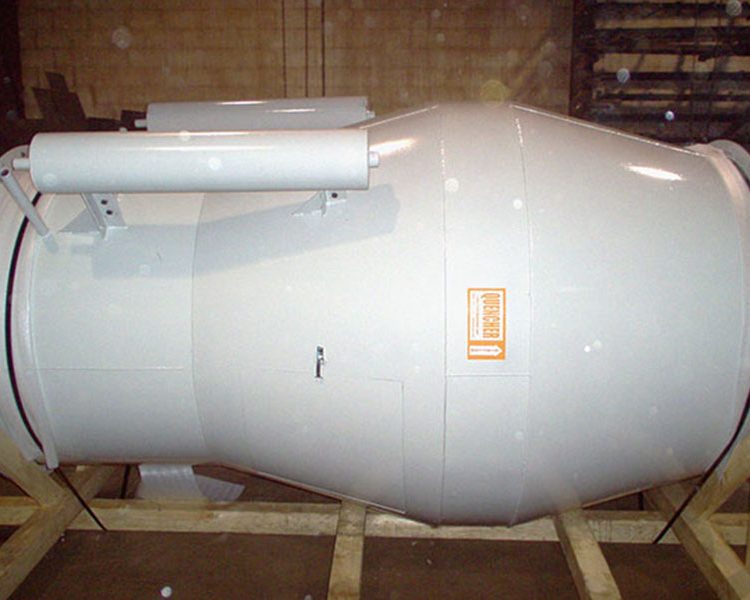
In-line spark arrestors (traps); http://www.qamanage.com/products/quencher_spark_arrestor.htm

Duct cleaner – boosters; http://www.qamanage.com/products/Booster.htm

Leakage From Dust Collector Outlet

Auto Date Tuesday, November 10th, 2009

Equipment:   Cartridge Collector with cellulose Media, 8 pleats per inch.

Application:  System designed to coat outside surfaces of gloves with starch to keep them from sticking together. It was effective and was meant for surgical use. The coating readily fell off the gloves when they were worn and before they were put to use

Observations: The starch dust was very coarse in the 5 to 10 micron size. The dust would easily fall from the fingers when squeezed and moved together. When the system pulsed large puffs of dust were observed at the collector outlet. We examined the dust under the microscope and it was uniform in size in the 5 to 10 micron range. However, the surface of the dust particle spheres were very smooth, almost polished. The collector ran with less than one inch pressure drop across the media, the same pressure drop as a clean cartridge. The lack of the ability to interlock the dust to form a cake meant that, during pulsing, the dust would tumble and could not agglomerate and this allowed the dust to penetrate the media during and after a cleaning cycle. The collector exhaust was returned to the work space, dust and all.

Recommendations, action, remedy and conclusions.
We recommended adding a small amount of ordinary cornstarch into the collector on an intermittent basis, once every four hours. This ordinary powdered (non-spherodized) starch formed a stable filter cake and the collector ran at 2 inches of pressure drop across the media, solving the penetration problem. The contaminated starch collected from the hopper was then sold for animal consumption but it was not a significant cost for the process.
Another solution was to use a standard tubular shaker collector with laminated (Gortex) media which does not require interlocking dust to form a cake.

This approach is suitable for other dusts that do not form granulated powders that don’t interlock to form a cake. Another example of this kind of dust was on a process where names were engraved on plastic. There was no granulated dust. The laminated media on cylindrical bags allowed the exhaust to be re-circulated.

Dust Collection Solutions and Applications and Troubleshooting

Cement Plant Dust Collection

Auto Date Monday, November 2nd, 2009

Although cement dust is relatively coarse and has optimum agglomeration properties, cement plants have some of the most demanding applications in the dust collection market.

First, all cement dust is dense and very abrasive. Even in the relatively less demanding application such as bag loading and bag unloading, these properties are important.

For many years, on the relatively light loading applications, shaker collectors were the preferred dust collectors. In fact the envelope collectors were very effective. The release of cement dust from shaker collectors was generally not a problem. In cylindrical bag collectors, the dust collected on the inside of the bag. The fastest moving air with its dust load was at the opening in the bag. There was a potential for wear near the bag entrance. If a bag developed a hole, the dust coming out of the tear would quickly abrade the surrounding bags. It seldom was possible to detect leaks until several bags, or even all the bags were damaged.

To filter a continuous process, off-line cleaning was necessary. On larger units, the collectors, in parallel sections or modules, were isolated and cleaned while maintaining flow through the remaining sections. On cement mills and other high load applications the collectors were usually preceded by cyclone pre-cleaners and the collectors often had dropout boxes or settling chambers.  On these applications, shaker filters ran at filter ratios below 2:1.  Air horns were often added to shaker collectors to improve cleaning and increase dust holding capacity.

In the late 60’s the Fuller Corporation introduced their version of the pulse collector. This compartmented collector had large diaphragm valves that discharged into the clean air plenum. The burst of air agitated the filter bags, producing a thorough cleaning. More dust collected on a unit of filter area to allow handling of heavier dust loads. The name of this collector was “Plenum Pulse”. It was able to handle the heavier load for applications such as raw mills and finish mills. The first installations vented clinker cooler vent systems. A measure of the efficacy of this cleaning system was that the clean air plenum was built with heavier gauge metal because of weld failure with 12 gauge construction. While this collector was touted to be a pulse-jet collector, it was not. The compressed air did not create a reverse air jet. The collector operated more like a shaker than a reverse jet design. It produced more energy to clean the bags than existing shaker designs. This was especially necessary on the heavier loading processes.

Another effort to handle this high loading was the combination of shakers and reverse air cleaning systems, provided by “Norblo” a company that was based in Cleveland Ohio.

However in the late sixties, MiKroPulverizer (later renamed MikroPul) and their then licensee, FlexKleen, introduced the reverse pulsejet collectors. They were first applied to vent the raw and finish mills in the cement production process. The reverse jet collector was developed by MikroPul for their Pulverizers. These were similar to cement mills and were able to handle the heavier loads of the cement mills without pre-cleaners.

These collectors ran quite well, with filter lives exceeding three to five years. Then in 1969, when MikroPul’s patent was challenged and declared invalid in court, many competitors copied their design. To counter the imitators, they made a major change in their design. The bag length went from six to ten feet. The pulse pipe orifice area was increased by the same ratio. Unfortunately, the venturi diameter was not changed. The velocity of the cleaning jet increased. It went from 15, 000 fpm to 25,000 fpm. Nobody recognized that the venturi velocity is proportional to the velocity of the dust leaving the bag towards adjoining bags during cleaning. In a dust like cement, it causes partial blinding and abrasive wear on adjoining rows during the cleaning pulse. Average pressure drops increased from 3 to 5.5 ” wc. Bag lives were reduced by 50-60%. Compressed air usage went from about 0.5 SCFM per 1000 cfm of filtered air to 1.2 SCFM per 1000 cfm of filtered air. To counter these effects, the industry made some basic changes in selecting pulsejet collectors. The changes treated the symptom rather than the cause.

  • Filter ratios were drastically reduced. Bag life was increased and pressure drop was decreased to the 5 inch w.c. range.   
  • Pressure actuated cleaning systems were introduced. This kept the abrading and blinding of bags from cleaning pulses to a minimum. (The cleaning frequency and air consumption per 1000 cfm of filter air remained much higher than with the old six foot long bag designs.)

The development of the ULTRA-FLOW advanced technology design was able to remedy all the shortcomings of the 1O foot bag design. These designs will be discussed in future papers of this series. Find out about Ultra-Flow at Advanced Technology Baghouse Dust collectors

Generally, the operators have chosen very conservative air to cloth ratios.  Cartridge collectors are quite effective on less demanding applications.

Application Engineering Data Filter ratio      Cartridges
The belief was that more filter media (and associated filter ratio) made the selection more conservative. This idea is firmly entrenched in the cement Industry. This is generally true with pulse jet fabric collectors with high velocity cleaning jets in that it extends bag life. The fact is that the opposite is true with cartridges because of bridging across the pleats if the media is not cleaned. As dust accumulates in the valley of the pleat, it bridges. During the cleaning cycle the cleaning air looks for the easiest path from the inside to the outside of the filter cartridge. That path is above the bridge.

What contributes even more to this phenomenon is the fact that a certain volume of reverse air can only clean a certain amount of media. Because the cartridge may contain huge amounts of media that cannot be cleaned, the media not cleaned will plug. In most designs running at filter ratios of less than two, an operating cartridge may contain 10 to 40 pounds of dust. Table 1 illustrates the area of media that can be cleaned with various orifices and /or converging diverging supersonic nozzles.

TABLE 1

Orifice / Nozzle diameter = area of media cleaned

0.250 in = 5.5 / 8.8 sq.ft.

0.312 in = 8.6 / 13.75 sq.ft.

0.375 in = 12.3 / 19.8 sq.ft.

0.500 in = 22 / 35 sq.ft.

0.750 in = 49.5 / 79 sq.ft.

1.000 in = 88 / 132 sq.ft.

1.500 in = 198 / 376 sq.ft.

There are new advanced technology cartridge dust collectors available today which incorporate wide pleat spacing, vertical cartridges, and supersonic nozzles, and, can be found at Advanced Technology Cartridge Dust Collector

Dust Collector Selection

The best designs for a fabric media pulse jet collector on these applications are those offered by ULTRA-FLOW with low jet velocities and higher filter ratios.  The characteristics of these designs are listed below:
Average velocity at bag opening  = 10,000 feet per minute
Bag opening (no venturi) = 4″ diameter
Jet volume  = 740 CFM
Bag diameter and length  = 4 inches x 96 inches
Bag area  = 10 sq. ft.
Filter volume rating per bag  = 190 CFM
Nominal filter ratio = 20 FPM
Average pressure drop  = 2 1/2 inches water column
Average Air Consumption  = 1/2 SCFM/1000 CFM of flow
Average dust penetration at 5 gr. / cu. ft. load  = 0.0005 gr. / cu. ft.

Conclusions

The best dust collection choices are a fabric collector with low jet velocities and a high inlet. The filter ratio is dependent on what the customer will accept, but ratios of over 18:1 are easy and reliable. Some modifications must be made to the inlet baffle because of abrasion.

Welding, Laser & Plasma Arc Processes

Auto Date Wednesday, September 16th, 2009

Welding

Two Stage Electrostatic Collectors; Venting welding fume operations poses some difficult application decisions. Years ago, the preferred method of collecting weld fume was with two stage electrostatic precipitator dust collectors. These had several advantages; they were relatively compact and were generally very effective on general ventilation applications. They could handle relatively large gas volumes through the collectors and generally were located near the roofs of buildings.

Efficiencies of general ventilation; The collection efficiency was variable depending on the velocity going through the collection plates. The lower the velocity through the collectors the higher was the collection efficiency. The same collector might have an 80% collection efficiency at 6,000 CFM and a 98.5 % efficiency at 1,000 CFM The same collector could be applied to different exhaust volumes that would vary as much as a ratio of 6:1. The higher the volume would produce the lowest efficiencies. But the same air would be re-circulated and an acceptable level could be maintained in a particular room or building.  The cleaning of the precipitators were accomplished by a detergent wash system.
Loading for general ventilation; The loading for general ventilation units were from 0.1 to 0.5 grain per thousand cubic feet of volume. The washing frequency was typically once or twice a week. The presence of condensed hydrocarbons along with the fume was not a problem. Generally these would be oxidized into solids by the time the filter was washed. These collectors were generally the same ones that were applied as air filters in HVAC systems. The washing systems were designed for 1000 cycle life. This would translate to over ten years of life under these low loading conditions.

Hooded Systems; The trend was to hood the welding operations. The venting of hoods had some pronounced effects on the application of these precipitators. The load would vary from 5 to 20 grains per1000 CFM.

Effects of hooded systems; Usually the washing requirements were to wash the filter every shift or twice per shift because the load was so much higher. On a two shift operation, and washing twice per shift, the washing system had a life expectancy of less than 52 weeks.

Plating; It was necessary to operate particular precipitators at lower volumes with their associated higher efficiencies, because of a phenomenon called “plating” Referring to figure 1 below:

fig 1

The precipitator will ionize the gas and the particles. As the dust passes through the precipitator it forms a bubble type shape, containing charged particles, which were not collected on the collection plates. The gas quickly loses it’s charge. However the dust that was not collected keeps it’s charge a little while longer and loses its charge as it leaves the boundary of thebubble marked “A” in figure 1. If the precipitator has a low efficiency the bubble is much bigger as marked by “B”. This low efficiency bubble is 2 to 20X as bigger in volume than the high efficiency bubble.
Under certain atmospheric ambient conditions, this low efficiency bubble starts to grow rapidly until the whole room atmosphere is ionized and the room and all the contents become collection plates for the dust. The dust s attracted to the walls, windows, machines, eyeglasses and every object that is grounded. All the surfaces turn blackened within seconds. There have been cases where this happened after the walls were painted white. After the atmospheric conditions go back to normal the plating stops
Bad Inlet conditions. All precipitators either single or two stage need even velocity distribution across the plates. If we had a gas stream averaging 100 fpm that would be designed to operate at 95% collection efficiency and  the real velocities entering the plates varied from 50 to 150 fpm, the section at 50 fpm might have a collection efficiency of 98% and the section at 150 fpm would be running at 80%. This would mean that the overall efficiency might operate at close to 85%. This condition would cause phenomenon described above
Lower Efficiencies, caused by running at lower average velocities were common. In the example above the collector might be selected to run at 125 fpm and an average efficiency of 85%. Plating may be produced because of these lower velocities and lower collection efficiency. As a result, many collectors were purchased based on volume and the supplier’s guaranteed higher collection efficiencies. There were practically no way to specify the collectors except based on supplier claims. Velocity was not a good criterion. Some collectors at relatively higher velocity and longer sets of collection plates would achieve the same result as a collector with short plates and a slower velocity.
Electrical Controls; To further aggravate the problem improper electrical controls were offered. Some operators interpreted SIC controls to mean arcing was not allowed. To eliminate the arcing across the plates, they lowered the voltage controls to halt this sparking. Unfortunately the voltage was lowered so much that the particles were not charged. There were cases where the metal pre-filters were more efficient than the precipitators.
Insulator Coating; The main collection plates are at ground in a two stage electrostatic precipitators. The charged particles will be attracted to the lower voltage intermediate voltage level plates and to the grounded collection plates. The insulators were also at ground level and some of the dust (a very small percentage) stuck to the surface of the insulators. This was a very strong bond and the spray cleaning systems could not keep these insulators clean. Eventually they were coated badly enough that the power supply could not keep the charging electrodes to ionize the gas and the particles. To correct this problem required a major overhaul of the precipitator. The charging electrodes were made of very fine wires and would eventually break and require replacement. Most electrical maintenance men were not familiar with high voltage supplies and maintenance was neglected.
Innovations in Design; In the late 70’s, two stage precipitators with pressurized insulators and more rugged washing systems were introduced. The insulators were subject to a gas stream that entered the collection compartment at a higher velocity than the collection velocity across the plates. This protected the insulators from charged particles. The charging electrodes were made heavier to give much longer charging electrode life.
These innovations increased the collection costs with electrostatic collectors to the point where cartridge dust collectors introduced at the same time were more economical to purchase and operate.
The advantages of the electrostatic collectors were:

  1. The pressure drop was constant and usually low.
  2. They could collect liquid droplets
  3. They had the potential of long periods of service without maintenance.

Cartridge Dust Collectors
With the development of cartridge collectors, another method of collecting fume dusts became available. The standard design pulse jet fabric collectors with cylindrical bags did not work because the cleaning systems propelled dust through the cake of adjoining rows of bags during the cleaning cycles. In the late 70’s and early 80’s thousands of cartridge collectors were applied to both hooded and non-hooded ventilation systems.
Problems developed in many systems after the mid eighties. High-pressure drops and short cartridge life developed in many systems. The causes were one or more of the following:
The presence of thin films of oil on the surface of the parts that were welded. When electrostatic powder coating finishing systems were widely applied to reduce or eliminate hydrocarbon generation from paint systems, the faces of steel parts required protection from oxides on the surfaces. During the welding process condensing hydrocarbons were liberated and swept up into the ventilating systems and their associated collectors. One of several results followed:
a) The solids to liquid ratio was so high that the dust blotted the liquids and the collection system was not affected by the liquid droplets.
b) The solids to liquids ratio was in range where the powders and hydrocarbon mixture formed a paint and the collection media was gradually plugged. This could take days, weeks or months, but the net effect was the  cartridges had to be replaced or laundered pre-maturely.
c) The solids to liquid ratio was so low that liquid wetted the cartridges and they were plugged as in (b) above. Even in cases where the coating was barely discernable, this could occur.

A case in point was in a plant making stainless steel mufflers. The metal was washed after forming and the load in solids was 0.02 grains per 1000 CFM, the pressure drop rose in a six month time period. The re-enforced cellulose media would be air-dried and the pressure drop would be reduced from six inches to 0.3 inches after the elements were installed. After 4 months the pressure drop went up to six inches. After washing the pressure drop went down to 0.8 inches.  The next washing cycle came two months later and the pressure drop returned to 1.2 inches. It was less expensive to replace the cartridges than to wash them in such a short interval.

Washing cellulose media cartridge elements: After each washing, the media is wetted, the permeability of the media diminishes, even if no dust remains at or below the surface of the media. The wetting causes the media to matt. If oil wets the media it is a good blotter and the fibers may grow. This causes the pressure drop and base permeability to decrease.
Other media are available that can be washed and are not wetted by oils. These are referred to as oleophobic media. This is a coating on the fibers that does not change the permeability. Otherwise they will be called washable. Often they can collect a mixture of fumes and hydrocarbons because the fibers do not swell.
Treated Spun bond medias are widely applied. Some of these are excellent choices but have limitations. For instance, with tight pleats, the top of the pleat may squeeze so the media in that portion of the pleat may make contact on the clean side when the pressure drop rises. On some applications, over 80% of the pleat of the media may not be effective.  The remedy is one of the following.
A) Provide pleats with wider spacing and make them shorter in depth. This will allow full use of the media    available in the filter element.
B) Provide a media that has stiffness and will not collapse on itself.
C) Provide a laminated media with the clean side backing very open so that if the pleat squeezes there will be flow through the media.

Fume Generating Processes Similar to Arc Welding and Gas cutting

Thermal Deposition Processes
Spray Coating The first type was a flame spray coating machine. These fed a material into a high heat gas torch. The temperature achieved was so high that feed material would produce a material in gaseous/liquid form that started to condense into molten droplets. Though the process is not understood, it is presumed that some of the adhesion was from a nuclear bonding, in addition to the cooling of the molten droplets on the piece to be coated. There were some materials that were too porous and there was limits to the thickness of the coating. The over-spray that did not adhere varied from about 5 – 20% of the material fed into the coating generating gun. The over spray was generally collected by medium pressure air washer scrubbers at a 99% collection efficiency.
Plasma Arc Spray To get smoother surfaces and better adhesion to the target surfaces, an electric arc was added to gas flame. This produced much higher temperatures in the gun at the point where the powder or wire feed entered. It generally produced more over spray (10%-40%). This over spray was much finer and would lose its ability to stick and adhere to surfaces. This over spray was too fine to be collected efficiently with air washer wet scrubbers. Fabric or pleated cartridge collectors were necessary.
One serious problem was encountered. This involved residence time of the dust between the gun and the media collection surfaces. In a system installed in 1975, on a plasma arc spraying machine for coating electrical capacitors. The process was coating plastic surfaces with metal. The cartridge collector filter elements, venting the over spray, plugged up in less than ten minutes. The six cartridges each with 50 square feet of filter, (300 sq. ft. total) received less than 250 grains of dust. The dust collector was connected within 20 inches of the gun. The over spray dust adhered to the media surface and blocked the pores.
Through experimentation and field experience it was determined that if the dust stayed in the gas stream for relatively long periods of time, it would lose its ability to coat the media. Depending on various factors such as the feed rates of gas, solids and the arc current, this time varied. It varied from 0.5 to 1.0 seconds. Referring to the figure, the residence time will be analyzed.

Figure

The part to be coated is placed in a hood with the gun at the front of the hood. The hood is 6 foot long and is rectangular with a 4 x 4 opening.  The face velocity of the hood is 350 feet per minute. The duct is sized at a 2500 feet per minute duct velocity and the duct is 15 feet long. We will assume the back of the hood has a transition 2 foot long, designed like an evasé to have uniform velocity distribution.
1) Time to travel through the hood 6 ft / 350 FPM = 0.017 seconds
2) Time to traverse duct to the collector 15 ft / 2500 FPM = 0.006 seconds
Residence time = 0.017 + 0.006 = 0.023 seconds.
The flow through the system is 350FPM x 16 sq. ft. =  5600 CFM

To re-design collection for longer residence time the length of travel in components are altered and the velocity can be modified. The hood is the first to be looked at.

residence chamber

3) The hood would be made 10 foot wide with the same 4 foot by 4 foot opening for the gun and part. The velocity in the wide part of the hood would be 5600 CFM / 100 sq ft = 56 FPM
The residence time in this portion of the hood would be 18 feet divided by 56 FPM = 0.32 seconds.
4) The duct could be extended to 200 ft by putting in ductwork in a “serpentine fashion” and enlarged to drop duct velocity to 1,000 FPM. The residence time in duct would be 200 feet/ 1000 FPM = .0.20 seconds

The residence time of the system would be 0.32 + 0.20 = 0.52 seconds.

High Temperature Cutting Processes
This high temperature flame coming from the gas gun proved to be an excellent improvement in flame cutting. Instead of jagged edges near the cut, it became much smoother and for most applications it did not require smoothing the edge or the operation was very quick. With digital cutting machines the precision rivaled other cutting processes.

Plasma cutting and laser-enhanced cutting are in common use. The type of dust produced runs the gamut from arc welding to that of metalizing operations. Most dust is more similar to venting systems for arc welding operations, but to get some cutting characteristics the temperature and flow in the gun are adjusted. This may produce a dust that is prone to coat surfaces and media.  When this happens the residence time requirements may be in the same range as the electro deposition processes. Laser cutters work well with 1 second residence time. Some flame cutters have been applied to non-metallic pieces such as wood and plastics. These dusts can contain tars, and oils from non-metallic parts and the collector media can get plugged easily, within a few seconds. With metallic parts, the oils can be an imperceptible film on the metal or originate from the compressed air compressor. In that case, a low-pressure scrubber may be a good choice. Roll filters with replaceable media or a self-feeding pre-coat material system have been employed.
It is crucial to have the correct airflow at initial start-up. Too much airflow will reduce residence time and cause the painting effect. Install a control damper in the main duct and use an approved method to accurately measure the exact airflow. Use the damper to choke the system if needed.
Recently, it has come to our attention that some plasma cutting processes are throwing out the 1 second residence time rule of thumb. Either the process temperature is being cranked up so high that the molten metal atoms still don’t have enough time to form molecules or the dust concentrations are so low that the atoms never get a chance to collide with one another in the laminar flow of the duct system. In these cases, finding the correct residence time
is almost a trial and error process. A new product has come on the market, called a Quencher, which is inserted in the ductwork as close to the source of dust as possible and no less than 10 duct diameters upstream from the collector. This device imparts a high energy multi-directional swirl to the airstream which cools the metallic atoms, accelerate their oxidization, and forces them to collide together and form molecules which can safely be collected without the painting effect.

De-agglomerating dust
Normally we would run a properly designed dust collector at 1 to 1.5 inch water column pressure drop.  Sometimes a system will only stabilize at a higher reading (E.G. 3 to 4 inches). One possibility is that it takes 3 to 4 inches to a agglomerate and fall to the hopper.  It may be de-agglomerating when you pulse at lower pressure drops.  In that case off-line cleaning should drop out the de-agglomerating dusts.  Some dusts are more susceptible to this phenomenon than others.  Often, they put an anti-rust wipe on the material being cut.  If it contains ceramics then we will have this problem.

To get more information:

Consulting services

Quality Air Management

CLEANING OF BLINDED BAGS FROM POWDERED DUST

Auto Date Wednesday, August 5th, 2009

May, 2009
Tire Recycling plant, Dunnville, Ontario
Equipment; Baghouse Dust collector collecting from hammer mills
Dust; rubber, synthetic fibers, steel wire, carbon

Occasionally, the filters in a shaker or pulse cleaning dust collector will lose their efficacy because of moisture or other liquids entering the collector.
1) The base filter media will be coated with moisture. In general if the media does not absorb moisture the filter elements can be recovered if the pressure drop has not reached levels over 15-29 inches depending on dust characteristics. The load of dust must be then stopped and the flow through the collector is reduced to between 20% to 50% of the normal gas flow. These conditions should continue until the moisture is evaporated. The media cake will have been restored enough to allow reverse air to flow through the media and increase the permeability. Repeated cleanings will restore the media in the cleaning process so that it will be able to support an effective filter cake. This normally requires 10 to 40 cleaning cycles. The pressure drop should be monitored as it is possible to over clean the bags so that dust may come out the clean side and cause problems if the exhaust air is re-circulated to a work area. This procedure is effective if the media has not been physically or chemically attacked, (cellulose media will swell and lose its permeability when subject to repeated wet and dry cycles). Chemical or solvent attack presents more complex problems where the section of the media becomes critical. If the pressure drop is too high before the above process has begun, there is good possibility the dust can have imbedded itself in the fibers where the cleaning system can not restore the permeability enough to recover the filter elements.
2) The next possibility of blinding is due to a “painting” phenomenon. In that case the dust reaches the cleaning element surface in a paste or liquid paint form. It does not form a permeable cake. Usually there will be some powdered granulated dust that will be mixed with the paste. The ratio of liquid to powdered or granulated powder is critical. If the ratio of dust is very high, the collector will operate normally. Many processes do have occasional loads of liquid dust such as when dew points are high. The pressure drop rises and falls temporarily but the operations are satisfactory.
Our examination and testing of the bags revealed that in this process in which automotive tires were recycled to recover the metal and the rubber through hammer mills there was a dust/paste mixture reaching our continuous cleaning pulse jet collector that had a high proportion of liquid paste compared to the granulated powder. The bags were completely blinded. We sent them through normal fabric laundering process that removed a lot of the dust but were still badly blinded. We concluded chemical attack but the base fabric was as strong as a brand new bag.

We then subjected the bag to some deep cleaning procedures that are used to clean grease and sludge from some commercial and industrial processes. It was a last ditch effort to investigate the problem. We were applied our technology from related fields to develop a procedure to clean the bags and restore the media to virgin conditions. Cleaning the bags is challenging and can be somewhat messy. In addition it has some other hazards notably those involving the risk of fire and toxicity when inhaled. To address all these concerns we are proposing a three step cleaning process which addresses these concerns. These we shall refer to as coarse cleaning, medium cleaning and fine cleaning.

These are listed below.
1) Coarse cleaning is meant to remove the most of the dirt (by weight) clinging on the bags. Our first step was to separate the bags into groups of five and lay them on a concrete floor with three inches between the bags when they are laid side by side. The worker starts at the open top of each bag with his feet standing on the bags with about a foot between his shoes to brush the dirt into the space between the bags until he comes to the closed end.
2) This procedure is repeated for all five bags in the set. The dust is then swept with a hand brush and dust pan to be disposed of or recycled to the process.
3) The bags are turned over and the same procedure applied again.
4) Medium cleaning is meant to remove much of the remaining dust. Tie the open ends of the bags with a cord and put them in a laundry tub with clothes washing detergent. Swish them around in the tub and then rinse.
5) Final cleaning will get out the hardened paste by dissolving the hardened paste {latex type paint} it also can be used to strip latex paint from a piece of canvas. We use a surfactant compound that we use in cleaning grease in commercial [restaurant grills.] and high speed industrial machining to collect submicron smoke and oil mist. We use these in our other product lines. The surfactant powder can be ordered from our lab facility in Charlotte, NC.
6) After the bags are rinsed in step 4 above they are again put in a laundry tub with one cup of the surfactant powder in each tub, if multiple tubs are used. They are swished around and rinsed as in the medium wash.
7) Finally, they are hung up to dry.
8) We can check one of the cleaned bags to be sure that they have recovered enough to use. You can send the bag to our office in Waterloo to test permeability.
9) Give one pint of Canadian whisky to each of the workers who cleaned the bloody bags.

Retrofit and Dust Collector Consulting

Condensation in Dust Collectors

Auto Date Monday, June 15th, 2009

Let’s look at three service reports which illustrate the problems of condensation and outline the possible solutions.

London, Ontario Installation;
Cartridge Dust collector retrofit on Plasma cutting stations
The client complained of having to service the cartridges every 1-2 days because they would plug up. The pressure drop across the collector would rise to 8-10 inches water column. The cleaning system was totally redesigned, and six 36” high ratio style cartridge filters replaced twenty-four 26” tandem cartridges. 80/20 paper blend cartridges were installed temporarily until special anti-pinch style polyester filters could be supplied. Within two days the paper cartridges blew apart, mostly at the closed end-cap. They did run the pulsed cleaning system at 100psi instead of 85psi, with no regulator on the line. However, that was not enough to rip the media apart, so, something else was the cause. Upon inspection of the cartridges, we observed that the media was dry but had the look of being wetted. Also there were watermark stains on the clean side of the media. There was an accumulator tank on the compressed air line leading to the collector. The maintenance people told us the accumulator was installed because the valve manifold wasn’t large enough to hold enough residual pressure during a pulse. The manifold was just fine. What was happening is that the air line was very long (over 200 feet) from the compressor to the collector. Moisture would condense in the line then drop out at two elbows, which was the low point just before going up to the manifold. This choked the line which made the manifold appear like it was too small, and then suddenly a slug of water would blow through to the valves and into the cartridges. We recommended taking out the accumulator tank and, just before the connection to the valve manifold, installing an air line coalescing filter, top quality dryer, and a regulator set for 85psi. We also recommended an automatic drain valve system on the manifold tank. The collector now runs continuously at 3-3.5inch pressure drop. The client says they’ve never been able to control the contaminants at the plasma stations so well since they installed the system 1.5 years prior to the retrofit.

Maine Installation; Energy Recovery from Trash and garbage.
This collector installation was venting a large room where garbage was dumped. Front-end loaders took this garbage and carried it to the hoppers that fed an incinerator. Steam was produced that fed a boiler. The pulse jet collector vented 65,000 ACFM at ambient conditions. It was running at a 15:1 filter ratio and at 2 “ water column from January to June. In June the pressure drop started to creep upwards about 1/8 of inch per week. This collector was well instrumented with continuous recording of wet bulb and dry bulb temperatures as well as pressure drop. We compared the pressure drop increases with the weather reports in the local newspapers. The increases occurred early in the morning on days when the wet bulb and dry bulb temperature were closer than 5 degrees F. There were several kinds of trash being handled in the facility. We recommended that they not load the wet trash into the incinerator until after 10:00 a.m. This stopped the rising pressure drop problem. Since they shut the system down on weekends we recommended that they clean the collector for two hours on Saturday afternoon with the outlet fan damper 90% closed. This was almost as effective as off line cleaning and the dust was not blown back into the loading room during the procedure. The dust collector ran for at least two years, at less than three inches water gauge pressure drop after implementing these recommendations.

General Comments:  The cleaning system was running at 85 psig. Under typical conditions the compressed air expands to critical pressure which is 37psig. beyond this pressure, the pressure to velocity conversion stops and from 37 psig to atmospheric pressure, 0 psig, the energy is turned to heat from turbulence. This nullifies the refrigeration cycle as the compressed air expands to critical pressure. This collector used converging diverging nozzles which had a complete conversion of pressure to energy so that the refrigeration cycle was reducing the temperature in the jet by approximately 5-8 degrees F. Actually the turbulence below 37 psig causes some heat regain but the jet is still 5-8 degrees cooler despite this. Without the regain it would be about 9-12 degrees cooler. With a converging diverging nozzles the amount of cooling from expanded compressed air in the jet is a bit colder but the amount of induced air from the plenum is almost twice as much as with an ordinary orifice so the jet temperature is about 6-8 degrees cooler but not enough to make a difference. In Maine, the problem was mainly in the summer when the trash was wet from people dumping beer and other associated liquids. They did not have the problem in the winter when the trash was dry.

There were two other approaches that could have been used to counter the rising pressure drop:
1) Larger pulse valves and eliminating the nozzles. However, this would increase air consumption by over 35%.
2) Manifold heaters could be installed that would raise the temperature of the cleaning jet above ambient even to the point where wet garbage could be processed in high humidity conditions.
In either case, the collector could not handle vent volume where the gas entering the collector has condensed water droplets.

Low pressure compressed air, in the range of 7 to 22 psig is often employed for pulse jet cleaning systems. These have the same effect as the cleaning system with converging diverging nozzles since no turbulence occurs as complete expansion occurs in the orifice or nozzle. The best remedies are as follows:
1. Locate the low pressure compressor near the pulse valves and insulate the manifold leading to the pulse valves.
2. Use a manifold heater in the compressed air header, same as described above.

Other Comments and observations. There are many other installations in energy recovery plants that use high ratio reverse air fan collectors, The temperature regain on the reverse air fan is higher than ambient and eliminates condensation considerations described above.

East Tennessee Installation; Powder coating
This plant in the upper elevations in the mountains used a pulse jet collector to vent a powder coating operation that coated the internals of residential wash machines. This pulse jet collector started in July and ran until the middle of the winter when it developed a creeping rise in pressure drop characteristics. The wet and dry bulb spread was usually over 15 degrees F except early in the morning when it was about ten degrees. Investigation of the operation was conducted and we measured wet and dry bulb temperatures with a sling psychrometer mounted through a hole in the main vent duct. What we discovered is the booths were manually washed with a hot water hose every morning. At times the gas would go through the dew point for several minutes and then immediately go back to operation at a wide dew point spread. We recommended mounting a heater with a damper on a branch line to the vent system. The heater was triggered by pressure switches on the hot water hoses in each booth. This eliminated the creeping pressure drop problem permanently.

Use these links to obtain more information:
Dust Collector retrofits
Dust collection
Baghouse, cartridge dust collector

STAR BAGS

Auto Date Wednesday, May 20th, 2009

Below is a sketch of the Star Bag.

They came out about 10 -15 years ago as a pre-cursor to the pleated bags. It was a way to get the results of a cartridge filter style dust collector at high temperatures. Cartridges are limited to a maximum of 170degF. Also, the objective was to reduce dust penetration to adjoining bags during a cleaning cycle. It offered more surface area per bag to increase dust collection capacity per filter element. The dust collector could run at lower air-to-cloth ratios, thereby reducing the pressure drop. Our dust collector correspondence course teaches that this is a fallacy.

We believe someone in Canada makes these but we couldn’t tell you who. Some filter suppliers may know someone. These are very much more expensive than standard bags and cages. You can accomplish the same and have better results with a new advanced technology baghouse or retrofitting an existing dust collector to the new technology.

Ask for our free correspondence dust collector course and read numerous articles on dust collection technology at our internet website www.qamange.com.

Star bags in dust collectors

Star bags in dust collectors

Spark Arresters Prevent Fires

Auto Date Wednesday, April 15th, 2009

Transport of sparks through ducts; Referring to the sketch below, there is a glowing ember (red particle) surrounded by some hot air (yellow envelop) which gives the spark buoyancy. This spark and the hot gas associated with it can travel hundreds of feet in a duct. The ductwork is designed to give laminar (smooth ) flow. This is illustrated on the left. Spark suppressors are placed in the duct to change the flow to turbulent (coarse) flow, as shown on the right. This agitation or turbulence strips the air from around the ember thereby removing the fuel (oxygen), therefore extinguishing and cooling the spark below ignition temperature (pink particle).

Spark arrester

Spark arrester

Prevention depends on eliminating the causes of ignition. Spark traps can change laminar to turbulent flow and extinguish any sparks in a duct. Design duct systems for proper dust transport velocities. Install a pneumatic actuated duct booster to flush dust into the dust collector. Use air jets to remove electrostatic charges on the duct surfaces.

Quencher Spark Arrester, click here.

Filter (or air-to-cloth) Ratio as a governing specification: A Gross Engineering Mistake

Auto Date Monday, March 16th, 2009

New Advanced Technology eliminates design flaws; allows for High Ratio Operation.

The History of Reverse Jet and Pulse Jet Design and Development must be reviewed to determine proper selection of collectors.

The first pulse jet collector was developed by Pulverizing Machinery of Summit New Jersey in the early 60’s, to collect dust from their Pulverizers. They had tried to use the Blow-ring design but they could not handle the dust (powder ) loads as their grinder Pulverizers became bigger. The typical load to the collectors from the Pulverizers were between 150 and 300 grains per cubic foot. The collector design was based on the same blow-ring filtering velocities at these loads. The cages were based on available designs from shipping pulverizer shafts. The pulse valves selected were diaphragm valves that were the fastest and the lowest cost valve available. This valve happened to be a ¾ inch diaphragm pilot operated valve. They decided to use several valves in a collector and pulse them with an electronic timer. It was found the hole sizes and venturi formed  an air ejector design that had the same jet velocity that the blow-ring collector was using. But the big breakthrough came with the realization that the dust was ejected from the bag during the first 4 or 5 milliseconds of the valve opening. The valves were operated as fast as the mechanical design allowed. The operation was completed in less than 0.10 seconds. It became apparent that the frequency of cleaning was a function of the load to the collector. For instance for loadings of 300 grains the collectors would operate at a filtering velocity of between 7 and 9 ft per minute. At material handling facilities such as quarries, the collector would run at  velocities of 14 to16 feet per minute. The typical pressure drop in these collector designs were about 3.5 inches water gauge pressure for the high loads and  2.0 for the lower dust loads. The typical compressed air usage on the high loads were 1 to 2 SCFM  per 1000 CFM of filtered air. For loads under 10 grains per cubic foot, the air usage was 0.2 to 0.8 SCFM per 1000 CFM of filtered air.

Determining the filter velocity (then referred to as filter ratio) became a rather complicated procedure. The ratio presumably was determined by dust load, fineness of the dust, temperature of process gas stream, and other factors.

The hopper inlet was a carry over design from both the blow-ring collector and the previous mechanical shaker collectors.

By 1969, there were over 10,000 collectors in operation. Almost all of them were installed on process exhaust from Pulverizers or in foundries. Pulverzing Machinery changed their name to Mikropul and licensed FlexKleen to also build and Market collectors. The collectors for MikroPul had 4 ½ inch diameter bags 72 inch long and the FlexKleen units had 5 inch bags 102 inches long. Bag life was 3-5 years on Pulverizer applications and over eight years on low loading applications.

Engineering Disaster 1971

In 1971, the patent was challenged and the Pulverizing Machinery patent was declared invalid. The market changed radically because Air Pollution Control Regulations also became effective at the same time. Many new suppliers entered the market. In order to compete, Mikropul changed their design. They went from 6 foot to 10 foot bags. They increased their pulse pipe holes by the same ratio. The whole industry followed and copied the new design for hole size and venturi throat diameter. At the time, Mikropul had 40,000 venturies in stock and kept the same venturi sizes. This increased the jet velocity of the cleaning jet by 66 per cent.

This was when the dust collector market was growing at a 20% annual rate. With the new designs:
(1)    pressure drop increased to 4 ½ to 6 ½ inches w.c..
(2)    Compressed  air consumption increased by over 50% for similar applications.
(3)    Bag life was reduced by over 50%.
(4)    In reaction to these problems the filter ratios were reduced to between 4 & 6 on almost all applications.

Reasons for Disaster

What happened was no one at that time realized what might have been a rather obvious truth, that the velocity with which the dust is ejected from the bag during cleaning is proportional to the velocity of the cleaning jet. At the new velocities, dust is driven toward adjacent rows of bags in the filter mode. Depending on the dust density, the dust will be driven through the adjoining cake into the clean side of the bags. The cake becomes more dense and the pressure drop increases until the process stabilizes which takes 16-100 hours. Even after the equilibrium, the dust still penetrates and bag wear is high. With low filter ratios it takes longer for the bag to wear out and require longer times between replacements.

Today’s Conditions

This disastrous design continues to be employed by most of the pulse jet collector suppliers in the world.

New Technology eliminates design flaws

Twenty-four years ago a new technology was developed, a new pulse jet collector that basically changed the cleaning system design. The key to this design was to change the jet velocity to a fraction of the existing designs. New Technology eliminated the penetration of dusts from the row of cleaning bags to the adjoining row in a filtering mode.

This allowed pulse jet collectors to operate at:
(1)    lower pressure drops (1- 3 inches w.c.),
(2)    lower air consumption (50-75% less)
(3)    3 to 4 times longer bag life
(4)    filter ratios of over 14 : 1 on any application
(5)    decrease dust penetration by up to 90%.

There have been several suppliers building and selling these New Technology collectors since 1982. In fact the patents have now expired. There are over 4000 installations worldwide.

WHY IS THIS NEW TECHNOLOGY NOT ACCEPTED BY ALL THE MAJOR SUPPLIERS?

1)    If you produced 40,000 collectors after the development of the new technology was published over 20 years ago, you might be subject to legal action for poor judgment and causing the public to be overcharged for their dust collection.
2)    They do not have the engineering expertise to build these new technology collectors.
3)    People using the old obsolete technology control over 90% of the market world-wide.
4)    The suppliers of valves and filter elements would have their markets cut in half.
5)    Air compressor sales and service for pulse jet collectors would be cut by 60%

MODIFYING EXISTING COLLECTORS WITH ALMOST NO RISK TO THE PURCHASER.

We can supply new bags, pulse pipes and bag plugs to alter performance to high technology low pressure drop, reduced air consumption, lower penetration (immediately noticeable) and long bag life (it takes some time to verify that but it should be obvious from the other indications). The modifications take only a few hours and if a customer is not satisfied, he can return pipes and cages for credit and re-install the old components.

If this was not an absolute certainty customers would not pay for the equipment.

For more information go to website: http://www.qamanage.com/

Static Electricity and Dust Collector Systems.

Auto Date Thursday, February 5th, 2009

General Considerations
The effects of static electricity on the collection of dry particulate in fabric collectors is rather simple but misunderstood. For the most part, cartridge dust collectors experience the same issues.
First we must consider the cause of static charge build up in a collector. It occurs because the dust being collected is akin to a capacitor in an electronic circuit. In this day of computer chips the designer may not be familiar with this phenomenon. The capacity has two conductive plates separated by a layer of insulating material that has high enough insulation values that the static charge remains for relatively long periods. The charge can be removed by grounding one side of the capacitor. The charges then drain.
In dust collectors where the dust forms in the filter cake, the static charges may enter the collector on the surface of dry particulate dust. If the dust has high dielectric resistance properties, it can accumulate and build up in the filter cake. It can be viewed as many particles each carrying a static charge and acting like a miniature capacitor. The static charge will then build up on the surfaces and may reach a high enough level where a spark can be produced. This spark can trigger the explosion of explosive dusts.

Mechanical Cleaning (Shaker) Dust Collectors
In a fabric collector with a mechanical shaking mechanism to remove the dust, the collector is most vulnerable during the cleaning process. The dust is shaken from the filter bags in the process of shaking the cake, sparks sometimes are produced. Invariably, the dust/ gas mixture passes between the upper and lower explosive limits. A serious explosion may occur.
Usually these collectors will have explosion vents which relieve the high pressures that are generated in an explosion, presumably keeping the housing from being damaged and protecting the operating personnel near the dust collector.
In an attempt to keep this static charge from building to threatening levels, measures are included in an attempt to bleed this charge to ground. These include one or more of the following:
1)  Sewing in grounding wires into the filter media.
2)  Impregnating carbon or other conductive coating into the filter cloth.
These often give the designer a false sense of security in applying these to dust collectors. As explained above the dust, itself, insulates the charge and it remains in the cake until it reaches a point where a spark is generated. If the dust concentration is above the lower explosive limit and below the upper explosive limit, an explosion can occur. Fortunately, generation of the spark may not occur if the timing of the spark and dust concentration level do not coincide. An explosion does not occur in these cases.

Continuous Cleaning Reverse Jet Pulsed Dust Collectors
When dust, with the same properties described above, is vented in the same operations, using a reverse pulse jet cleaning system, the danger is considerably diminished unless the pulsing is applied in “off line” cleaning mode where the fan is stopped.
These collectors clean the bags by injecting air from the clean air plenum backwards through individual bags as the flow continues through the collector.   This cleaning agitates the filter cake so the static charges are dissipated.
The danger of explosion occurs when the dust concentration coming into the collector reaches a level between the lower and upper explosive limit concentrations. This is highly unlikely but we recommend that properly sized explosion vents are installed which normally coincides with the requirements of insurance underwriting firms.
The explosions can occur when there is dust build up in ducts especially when long horizontal runs are encountered. The spark can be generated in ducts and the explosion front can travel down the duct into the dust collector, igniting a secondary explosion as the concentration in the collector housing is driven above the lower explosive limit for that dust. Even with no build up in the ductwork, an upset can occur in the process which generates sufficient dust concentrations.
One method of nullifying the possibilities of danger due to duct build up is to install an automatic booster / duct cleaner device (www.qamanage.com/products/Booster.htm) . This booster can serve to automatically clean out any drop out in long horizontal duct runs.
Another phenomenon can affect of dust collector systems, is where the dust has high dielectric properties and the dust, because of static charges, will build up on the outside bend of an elbow. This dust can trigger an explosion if this dust is also flammable and explosive. Some examples of dust where this problem is often a factor are toners for copy machines and electrolyte powder used in alkaline batteries. The solution is to insert a pulsed air jet that agitates the built up dust that dissipates the charge. Some dry powder coating compounds are also subject to static charge build up in powder coating systems.

For more information see these web-pages:

Booster / Duct Cleaner; www.qamanage.com/products/Booster.htm

Quencher spark arrestor; www.qamanage.com/products/quencher_spark_arrestor.htm